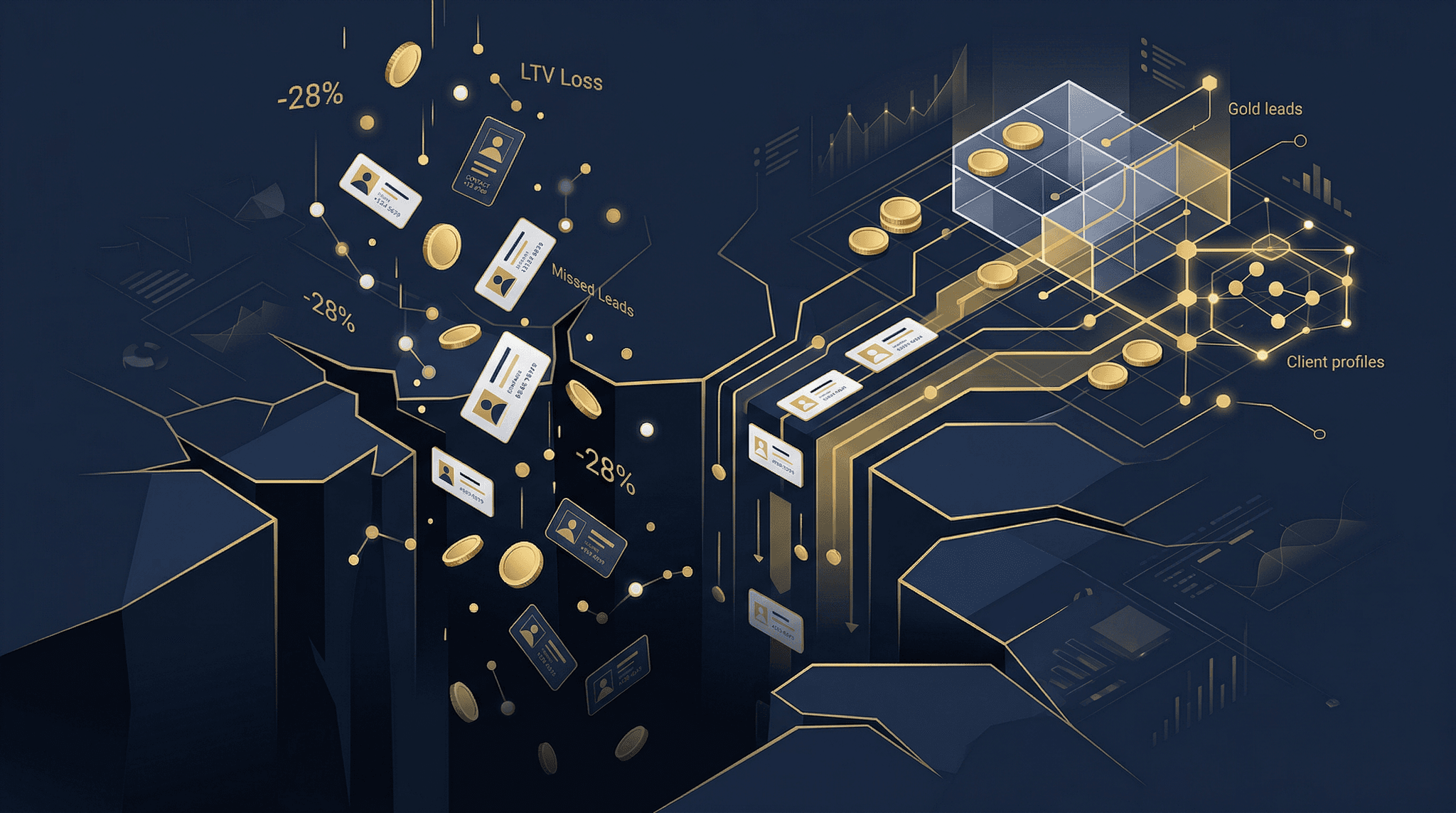
Every business has a follow-up problem. Not every business realizes it. The ones still managing leads through spreadsheets, email threads, and sticky notes are not just inefficient — they are hemorrhaging revenue through gaps they cannot see because nobody is tracking the losses.
According to Nucleus Research, the average CRM returns $8.71 for every dollar invested. That figure has held relatively steady across multiple studies because the value is not in the software itself — it is in the systematic elimination of human inconsistency from the sales process.
But the inverse calculation is the one that matters most. If a CRM produces $8.71 in return per dollar, the absence of one is not simply neutral. It represents a compounding loss — every missed follow-up, every untracked lead source, every prospect who quietly went to a competitor because nobody called them back.
The five specific costs outlined here are not theoretical. They are the documented patterns that emerge when businesses generating $500K to $10M in annual revenue attempt to scale without lead management infrastructure.
Cost #1: Missed Follow-Ups and the 80/5 Rule
The most expensive cost of operating without a CRM is invisible: the revenue from deals that would have closed with proper follow-up but didn't because the process broke down somewhere between "interested" and "sold."
Research from the National Sales Executive Association established what sales trainers call the 80/5 rule: 80% of sales require at least five follow-up contacts after the initial meeting. But 44% of salespeople stop after one attempt, and a full 94% stop after four.
The math is straightforward. Consider a business generating 80 new inquiries per month with a $5,000 average deal value and a 15% close rate:
| Scenario | Close Rate | Monthly Revenue | Annual Revenue |
|---|---|---|---|
| Without systematic follow-up | 15% | $60,000 | $720,000 |
| With 5-touch automated sequence | 25% | $100,000 | $1,200,000 |
| Difference | +10 pts | +$40,000 | +$480,000 |
That $480,000 gap is not hypothetical optimism. A carpet cleaning company went from zero digital presence to $57,000 in tracked revenue with a 942% ROI specifically because automated follow-up sequences ensured every inquiry received consistent, timed touchpoints regardless of which team member happened to be working that day.
The sequences were simple — a text within an hour, an email at 24 hours, a call reminder at 72 hours, another text at day seven, and a final follow-up at day fourteen. Nothing sophisticated about the content. The value was in the consistency.
Cost #2: No Single Source of Truth
Without a CRM, customer information lives in fragments — some in email, some in a spreadsheet, some in someone's phone contacts, some nowhere at all. This fragmentation creates problems that compound over time:
- Duplicate outreach. Two salespeople contact the same lead on the same day with different messages. The prospect feels like a number, not a person.
- Lost context. A prospect calls back after a week, and nobody remembers the previous conversation. The relationship resets to zero.
- Ownership gaps. A lead falls between team members because both assumed the other was handling it. Nobody follows up. The deal dies silently.
According to Salesforce's State of Sales report, sales representatives spend only 28% of their week actually selling. The rest goes to administrative tasks — data entry, searching for information, internal coordination. A CRM eliminates the searching and coordination overhead by making every interaction, note, and next step visible in one place.
The competitive disadvantage compounds daily. A business with fragmented data makes decisions based on incomplete information — which marketing channels work, which salespeople perform, which service lines are growing. A competitor with a centralized system can answer those questions in seconds and adjust strategy weekly.
Cost #3: Manual Tasks Consuming 10-15 Hours Per Week
The operational cost of managing leads manually is rarely measured because it is distributed across the team in small increments. Five minutes here to copy a phone number from a text message into a spreadsheet. Ten minutes there to compose a follow-up email from scratch. Fifteen minutes searching through old emails to remember what a prospect asked about.
McKinsey Global Institute research estimates that employees spend 28% of their workweek managing email alone. For a sales team without CRM automation, that percentage skews even higher because every communication requires manual composition and tracking.
Here is a partial list of tasks that a properly configured CRM system automates entirely:
- Instant lead capture from website forms, phone calls, and event registrations — no manual entry
- Automated welcome sequences — text, email, and voicemail drops triggered the moment a new contact enters the system
- Follow-up reminders — timed tasks ensure no lead goes cold, regardless of team workload
- Appointment confirmations and reminders — reducing no-shows by 30-50% through automated text/email sequences
- Pipeline stage updates — drag-and-drop deal tracking replaces spreadsheet gymnastics
- Review request automation — triggered after service delivery, generating Google reviews on autopilot
Conservative estimates put the time savings at 10-15 hours per week across a small sales team. For a business paying its salespeople $25-50/hour, that represents $13,000-$39,000 annually in recovered productive time — time redirected from administrative busywork to actual revenue-generating conversations.
Cost #4: Zero Pipeline Visibility
Without a CRM, answering basic business questions becomes an exercise in guesswork:
- How many active leads are in the pipeline right now?
- What is the average time from first contact to closed deal?
- Which lead source produces the highest-value clients?
- Where do most deals stall out — and why?
- Is this month tracking ahead or behind the same month last year?
According to HubSpot's State of Sales report, companies that use a CRM for pipeline management see a 28% improvement in sales productivity and a 29% improvement in revenue. The improvement is not because the CRM makes salespeople better at selling. It is because visibility enables better decisions — which leads to prioritize, which channels to invest in, and where the process is breaking down.
The strategic cost of invisible pipeline data extends beyond sales. It affects hiring decisions (do sales need more capacity or better conversion?), marketing budget allocation (which channels deserve more spend?), and service delivery planning (what does next quarter's workload actually look like?).
Cost #5: Inconsistent Customer Experience
The final cost is the hardest to quantify but may be the most damaging long-term. Without a system governing the customer journey, experience quality depends entirely on which team member happens to handle the interaction.
Research from PwC's Future of Customer Experience survey found that 32% of customers would stop doing business with a brand after just one bad experience, even if they loved the brand previously. And 73% point to experience as a key factor in purchasing decisions.
In a business without a CRM:
- One client gets a follow-up call within an hour. Another waits three days.
- One prospect receives a professionally written email sequence. Another gets a hastily typed text with no greeting.
- One customer gets a review request after a successful project. Another never hears from the business again until they are needed for another sale.
This inconsistency is not a people problem — it is a systems problem. The best-intentioned team member cannot deliver consistent experiences at scale without a system that standardizes the process while allowing for personalization within that framework.
The "Too Complicated" Objection
The most common reason businesses cite for not implementing a CRM is complexity. "The last one was too confusing." "My team won't use it." "The setup process seems overwhelming."
These objections made sense in 2015. They are less defensible in 2026. Modern platforms designed for small and mid-market businesses — rather than enterprise sales organizations — can be configured and operational within two to three weeks. The typical onboarding timeline looks like this:
- Week 1: Audit and configuration. Map existing processes, import contacts, configure pipelines and automation triggers.
- Week 2: Build automations. Create follow-up sequences, appointment reminders, and review request flows. Integrate with existing website forms and calendar tools.
- Week 3: Training and launch. Team training on daily workflows. Begin processing live leads through the system.
The complexity objection often masks a different concern: the business does not have confidence that the implementation will actually be maintained. That concern is legitimate — CRM solutions work best with ongoing support rather than a one-time setup that nobody touches after the first month.
Quantifying the Total Cost
Adding the five costs together for a business generating $1M in annual revenue with a four-person team:
| Cost Category | Estimated Annual Impact |
|---|---|
| Missed follow-up revenue | $200K–$480K |
| Fragmented data decisions | $50K–$100K (misallocated budget) |
| Manual task time waste | $13K–$39K |
| Pipeline blindness | $30K–$80K (missed optimization) |
| Inconsistent experience | Unquantified but compounding |
| Total estimated cost | $293K–$699K annually |
Even taking the conservative end of these estimates, the cost of not having a CRM dwarfs the investment in implementing one. Typical CRM implementation and ongoing support runs $500-$2,000 per month — meaning the system pays for itself in the first month if it recovers even a fraction of the missed follow-up revenue.
The Question Worth Asking
The real question is not "Can the business afford a CRM?" It is "Can the business afford to keep operating without one?"
For businesses ready to understand what a CRM implementation would look like for their specific situation, a free business assessment identifies the specific follow-up gaps, automation opportunities, and revenue recovery potential. The assessment takes two minutes and produces a concrete recommendation rather than a generic sales pitch.
For those who already know their follow-up process is broken, a discovery call provides a direct conversation about the specific situation — what a properly configured system would look like, what the implementation timeline involves, and what results to expect in the first 90 days.
The businesses that break through revenue plateaus are rarely the ones that find more leads. They are the ones that stop losing the leads they already have.